
Choosing the right motor and propeller for an industrial multirotor should not require a degree in aerodynamics. When you cut through catalog hype and marketing slogans, propulsion sizing comes down to one single question: Does the motor operate at peak electrical efficiency right where your drone spends 90% of its mission—in steady hover?
If your propulsion system is too small, your aircraft hovers at over 55% throttle, leaving minimal control margin for wind gusts and risking motor overheating. If it is too large, you carry hundreds of grams of useless motor weight and lose precious flight minutes.
The IPET I-Series integrated powertrains (motor, FOC ESC, and folding propeller) are factory-matched to hit their highest efficiency sweet spots at verified industrial hover points. This quick guide shows you how to pick the right model for your airframe in under 3 minutes.
1. The 30-Second Sizing Method (3 Simple Steps)
Before looking at motor specs, write down your aircraft target numbers and follow this straightforward 3-step checklist:
Take your all-up takeoff weight (MTOW)—including airframe, avionics, gimbal payload, and battery—and divide it by your number of rotors:
Example: A 12.0 kg Quadcopter (4 rotors) requires 3.0 kg of hover thrust per arm.
Look at our master table or the spectrum chart below. Pick the model whose Rated Hover Point is closest to your calculated per-rotor thrust:
Example: For 3.0 kg per rotor, the IPET I7 (rated at 2.68 kg, comfortably handling 2.5 to 3.5 kg) is your ideal match. Steady hover throttle lands right at ~44%.
For the complete mathematical calculation sequence, see our companion guide on How to Size Long-Endurance UAV Propulsion: Operating Point.
Measure your carbon-fiber frame to confirm you have enough physical clearance. Make sure propeller tips have at least 50 mm (2 inches) of clearance from the central fuselage and landing gear to avoid turbulent airflow.
2. Quick Selector: Which I-Series Fits Your Drone?
Use Figure 1 below to quickly locate your target takeoff weight and platform layout (Quadcopter vs. Hexacopter):
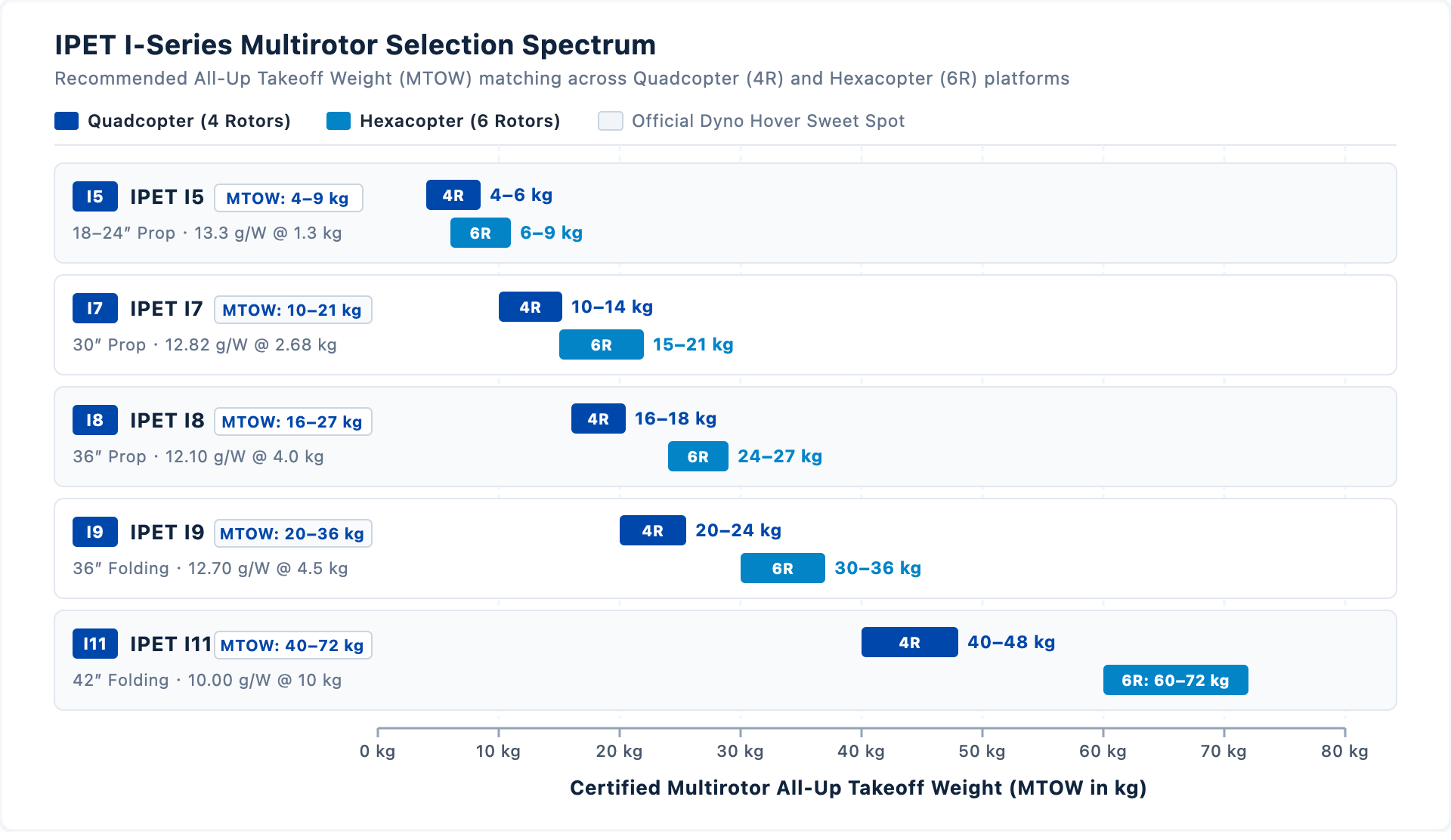
Propeller: 18″–24″ Carbon | Rated: 13.3 g/W @ 1.3 kg
Ideal for compact mapping quadcopters, lightweight photogrammetry sensors, and portable folding airframes.
Propeller: 30″ Carbon | Rated: 12.82 g/W @ 2.68 kg
The industrial workhorse for 10–14 kg quads and 15–21 kg hexas. Read our full build guide: How to Design a 10–14 kg Quadcopter Around IPET I7.
Propeller: 36″ Carbon | Rated: 12.10 g/W @ 4.0 kg
Built for maximum endurance on 16–18 kg quads and 24–27 kg hexas. Read our full build guide: How to Design a 16–18 kg Quadcopter Around IPET I8.
Propeller: 36″ Folding | Rated: 12.70 g/W @ 4.5 kg
Heavy-duty workhorse for 20–36 kg LiDAR platforms. Explore our Drone Propulsion Guide for Aerial Mapping & LiDAR.
Propeller: 42″ Folding | Rated: 10.00 g/W @ 10.0 kg
Industrial heavy lifter. Built for 40–48 kg quads and 60–72 kg hexas in cargo delivery and emergency logistics.
3. Authoritative I-Series Master Rating Matrix
Here are the official factory dynamometer ratings and hardware boundaries for the complete IPET I-Series lineup:
| Model | KV & ESC Spec | Propeller | Max Thrust | Rated Hover Sweet Spot | Recommended MTOW |
|---|---|---|---|---|---|
| I5 | KV135 · 6–8S FOC 20A | 18″–24″ Carbon | 4.2 kgf | 13.30 g/W @ 1.30 kg | 4–6 kg (Quad) 6–9 kg (Hexa) |
| I7 | KV80 · 12–14S FOC 50A (Max 61V) | I30 30″ Carbon | 7.5 kgf | 12.82 g/W @ 2.68 kg | 10–14 kg (Quad) 15–21 kg (Hexa) |
| I8 | KV75 · 12–14S FOC 50A (Max 61V) | I36-S 36″ Carbon | 11.0 kgf | 12.10 g/W @ 4.00 kg | 16–18 kg (Quad) 24–27 kg (Hexa) |
| I9 | KV68 · 12–14S FOC 50A (Max 61V) | 36″ Folding Carbon | 15.0 kgf | 12.70 g/W @ 4.50 kg | 20–24 kg (Quad) 30–36 kg (Hexa) |
| I11 | KV70 · 12–14S FOC 70A (Max 61V) | 42″ Folding Carbon | 26.5 kgf | 10.00 g/W @ 10.00 kg | 40–48 kg (Quad) 60–72 kg (Hexa) |
Bench Test Note: To learn how to independently evaluate dyno test reports and avoid catalog thrust traps, see our buyer guide on How to Evaluate UAV Endurance Test Data.
4. The 14–16 kg Dilemma: Should You Choose I7 or I8?
One of the most common questions our application engineers receive is: "My quadcopter weighs around 15 kg. Both I7 and I8 can fly it—which one should I buy?"
Figure 2 shows a direct, side-by-side trade study on a 14.5 kg Quadcopter (hovering at ~3.6 kg per rotor):
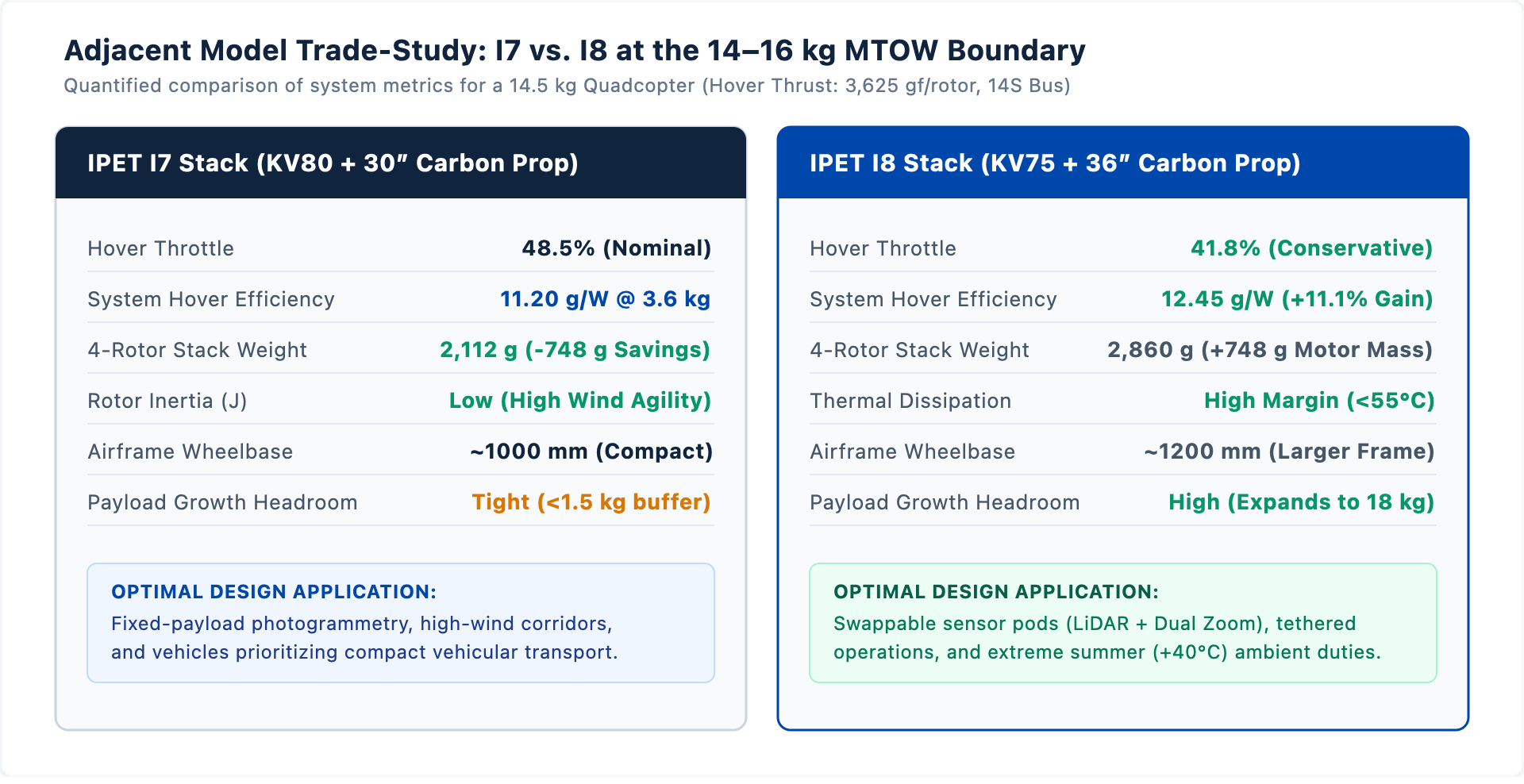
- Pick the I7 if you want a compact drone (1000 mm wheelbase) that easily fits in a vehicle trunk, saves 748 g of motor mass, and gives your flight controller fast attitude reaction in turbulent city gusts.
- Pick the I8 if maximum flight time is your #1 goal (+11% efficiency gain from larger 36″ props), if you fly in hot summer climates (+35°C), or if you plan to upgrade to a heavier LiDAR payload later.
5. Four Practical Rules Every Drone Builder Should Know
Standardize on 12S to 14S LiPo/Li-Ion packs (nominal 44.4V to 51.8V). Never exceed 61V under full charge or rapid motor braking, or you risk damaging the ESC MOSFETs.
The I-Series uses internal downwash cooling paths that keep out airborne dust and light drizzle while shedding heat. If your mission involves non-stop torrential downpours or ocean salt spray, choose our fully sealed IP67 N-Series instead. To understand thermal limits in wet environments, read Why Waterproof Drone Motors Overheat and our IP66 vs IP67 Sealing Guide.
I-Series ESCs are opto-isolated to shield sensitive autopilot sensors from high-power motor electrical noise. They do not have built-in BECs. Always power your flight controller and GPS from a separate, isolated DC-DC power module.
All I-Series ESCs support DroneCAN (UAVCAN v0). Connect one CAN cable to your flight controller to receive real-time motor RPM, bus voltage, current, and temperature right on your ground station screen.
6. Pre-Purchase Checklist (3 Things to Verify)
- ☑ Hover Throttle: Confirm that your calculated single-rotor hover weight lands between 40% and 48% throttle on our rated test sheet at 54V.
- ☑ Propeller Clearance: Confirm your frame provides at least 50 mm clearance between propeller tips and fuselage.
- ☑ Arm Stiffness: Ensure your carbon-fiber tubes have adequate wall thickness (minimum 2.0 mm for 30″ props; 2.5 mm for 36″ props) to prevent arm twisting under full throttle.
Our engineering team provides 3D STEP models, dyno curves, and custom arm layout reviews. Contact the IPET SYSTEM Applications Team to get your free evaluation kit.
Frequently Asked Questions
Choose the I7 (30″ prop) if you need a compact frame (1000 mm wheelbase) that fits in a car trunk and snappy control response in gusty winds. Choose the I8 (36″ prop) if maximum flight endurance is your top priority (+11% efficiency gain) or if you fly in hot summer climates (+35°C).
Yes, I-Series motors carry an IP46 industrial rating with internal centrifugal cooling channels that protect against airborne dust and splashing drizzle. For continuous heavy downpours, marine salt fog, or underwater submersion, select our hermetically sealed IP67 N-Series.
Yes. IPET I-Series ESCs use opto-isolated signal inputs to protect flight avionics from high-voltage commutation spikes. They do not have built-in 5V/12V BEC circuits, so your flight controller and payload must be powered from a dedicated DC-DC step-down module.
We recommend sizing your powertrain so that steady hover throttle falls between 40% and 48% at nominal battery voltage (50.4V–54V on 12–14S). This guarantees at least a 2:1 thrust-to-weight ratio for wind gust recovery and safe descent control.