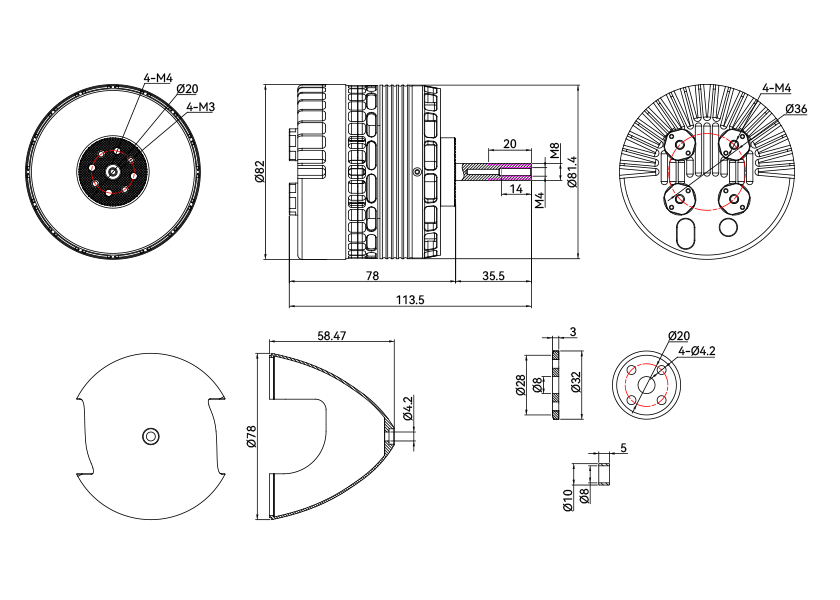

IPET IV7(7215)
An integrated IV7 (7215) propulsion system combining the motor, FOC IV150A ESC, and validated propeller configurations for 20–25 kg fixed-wing and VTOL UAVs. Designed for efficient cruise performance, compact installation, and real-time propulsion feedback.
Engineering Fit Check
Use these parameters for initial cruise-propulsion selection. Final sizing should be verified against airframe drag, cruise speed, operating altitude, cooling conditions, propeller clearance, and required power reserve.
Integrated by Design Validated as a System
The motor, ESC, and validated propeller configurations are engineered as one propulsion architecture. This reduces integration work, improves system consistency, and provides a defined starting point for UAV platform development.
Motor and ESC Integration
A compact integrated architecture reduces external wiring, connector count, and installation complexity while supporting more consistent electrical and thermal performance.
Matched Propeller Setup
Propeller sizing is selected around the motor and ESC operating range to balance thrust, efficiency, current draw, and thermal load at the system level.
Faster Platform Integration
A defined propulsion configuration reduces component sourcing, compatibility testing, and repeated tuning during prototype development.
System Level Performance Data
Thrust, efficiency, current, RPM, and temperature are evaluated as a complete propulsion system to support airframe selection and validation.
Built for Reliable Fixed Wing Cruise
Designed for the continuous operating demands of fixed-wing and VTOL cruise, with FOC control, shared-airflow thermal management, configurable propeller positioning, and redundant control and monitoring.
FOC Control and Shared Airflow Cooling
FOC control supports smooth and stable power delivery across the cruise operating range. A shared airflow path improves heat dissipation from both the motor and ESC during sustained output.
Adaptive Electronic Propeller Positioning
Configurable electronic positioning holds the propeller at a defined angle after shutdown and automatically adjusts the holding force against incoming airflow. This helps reduce blade-contact risk and supports lower-drag airframe integration.
For the validated KV200 and 20×10 propeller configuration, the function maintains the propeller position in incoming airflow up to 20 m/s.


Redundant Control and Real Time Monitoring
PWM and CAN provide two throttle-input paths for control redundancy. RPM and motor-temperature feedback support real-time propulsion monitoring and fault diagnosis when used with a compatible flight controller.
Secure Propeller and Mounting Interface
Anti-loosening stainless-steel fasteners, anti-slip teeth, and a removable locating pin help resist loosening and shear loads during installation, maintenance, and operation.
Where IV7 Fits Best
IV7 is intended for 20–25 kg fixed-wing and VTOL UAVs that require an integrated cruise propulsion system, validated propeller options, and dependable continuous power for long-range missions.

Long Endurance Mapping and Surveying
Supports fixed-wing and VTOL platforms carrying mapping cameras, LiDAR, and survey payloads, where cruise efficiency directly affects coverage area, route length, and mission productivity.

Linear Infrastructure Inspection
Suitable for long corridor missions along power lines, pipelines, railways, roads, and coastlines, where stable cruise output helps maintain consistent speed, altitude, and sensor overlap.

Remote Area and Environmental Monitoring
Provides a defined propulsion baseline for forestry, wildlife, coastal, and environmental monitoring platforms operating across wide areas with limited field support.