
In industrial UAV tenders, “long endurance” still dominates the spec sheet. Buyers naturally assume a longer-hover aircraft must be more productive. Field reality often disagrees: some long-hover platforms cover less survey distance or fewer assets per duty day than a lighter, faster aircraft with shorter catalog endurance.
The gap comes from confusing Flight Time with Mission Efficiency. This article defines a five-lens framework and anchors it to published IPET system ratings so OEMs can score duty days instead of hover minutes.
- Flight time is not productivity: Mission efficiency = validated deliverables ÷ total task time (deploy + flight + swap + turnaround).
- Score the operating point: I-Series rated hover efficiency is published per model (for example I7 at 12.8 g/W @ 2.6 kg/rotor; I8 at 12.1 g/W @ 4.0 kg/rotor).
- Mass fraction matters: As battery mass share grows, added cells increasingly lift themselves—keep pack mass fraction as a design constraint.
- Hover throttle window: IPET design guidance places efficient hover near the 42%–45% throttle band on the matched stack; high hover throttle is a productivity tax.
Flight Time vs. Mission Efficiency
- Flight Time = wheels-up to touchdown.
- Mission Efficiency = validated deliverables ÷ total task time (deploy + flight + battery swap + turnaround).
The Five-Lens Framework
| Lens | Endurance-only trap | Mission-efficiency requirement |
|---|---|---|
| 1. Duty cycle | Total airborne minutes only | On-task sensor time after commute legs |
| 2. Payload utility | Strip payload to win hover | Full sensor suite with power/thermal margin |
| 3. Coverage & dwell | Slow hover in calm air | Stable collection at operational cruise in real wind |
| 4. Energy logistics | One oversized pack | Field-portable packs and daily turnaround |
| 5. Operational stability | Calm weather only | Weather envelope for the site (All-Weather) |
Battery Mass Fraction and the Hover Window
Hover power rises faster than linearly with weight. IPET engineering guidance treats battery mass share as a design ceiling (commonly discussed near half of MTOW) and places hover in a mid-throttle efficiency window rather than at maximum thrust.
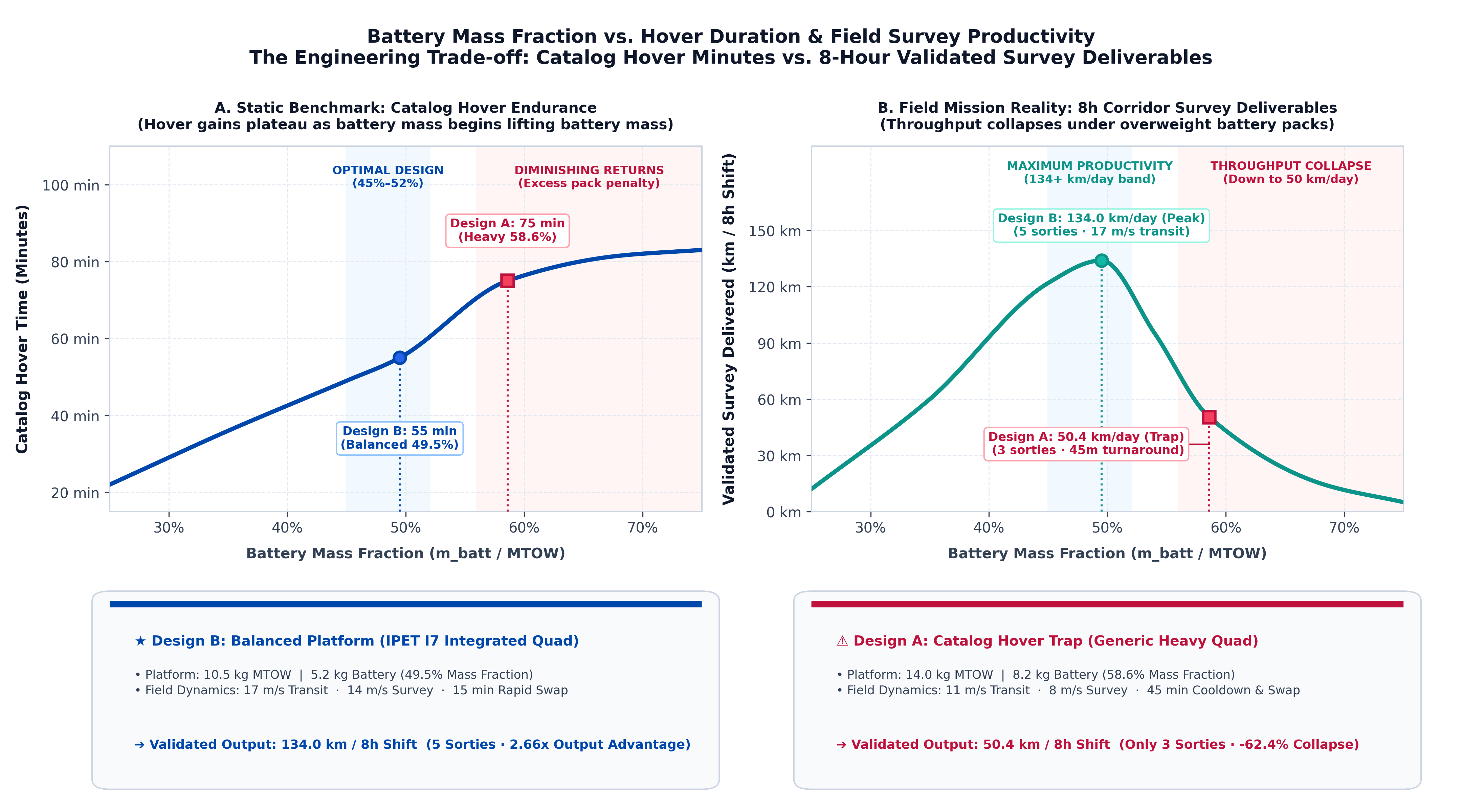
Rated system points show the same physics: on I7, bench efficiency is higher near 2.5–2.6 kg/rotor than near 4.0 kg/rotor on the same stack. Use the matrix when comparing platforms:
| Model | Bus / ESC | Prop | Max thrust | Rated hover efficiency | Quad / Hexa MTOW | Stack weight |
|---|---|---|---|---|---|---|
| I5 | 6–8S | 18–24″ | 4.2 kg | 13.3 g/W @ 1.3 kg | 4–6 / 6–9 kg | 350 g |
| I7 | 12–14S FOC 50A (max 61 V) | I30 30″ | 7.5 kg | 12.8 g/W @ 2.6 kg (peak 13.23 @ 2.5 kg) | 10–14 / 15–21 kg | 528±2% g |
| I8 | 12–14S FOC 50A | I36-S 36″ | 11.0 kg | 12.1 g/W @ 4.0 kg | 16–18 / 24–27 kg | 715 g |
| I9 | 12–14S FOC 50A | 36″ folding | 15.0 kg | 12.7 g/W @ 4.5 kg | 20–24 / 30–36 kg | 994 g |
| I11 | 12–14S FOC 70A | 42″ folding | 26.5 kg | 10.0 g/W @ 10.0 kg | 40–48 / 60–72 kg | 1,385 g |
Related empirical battery tiers on a 1000 mm platform: Why Bigger Batteries Don’t Always Extend UAV Flight Time.
Design Comparison Template: Quantitative 10 km Corridor Trade Study
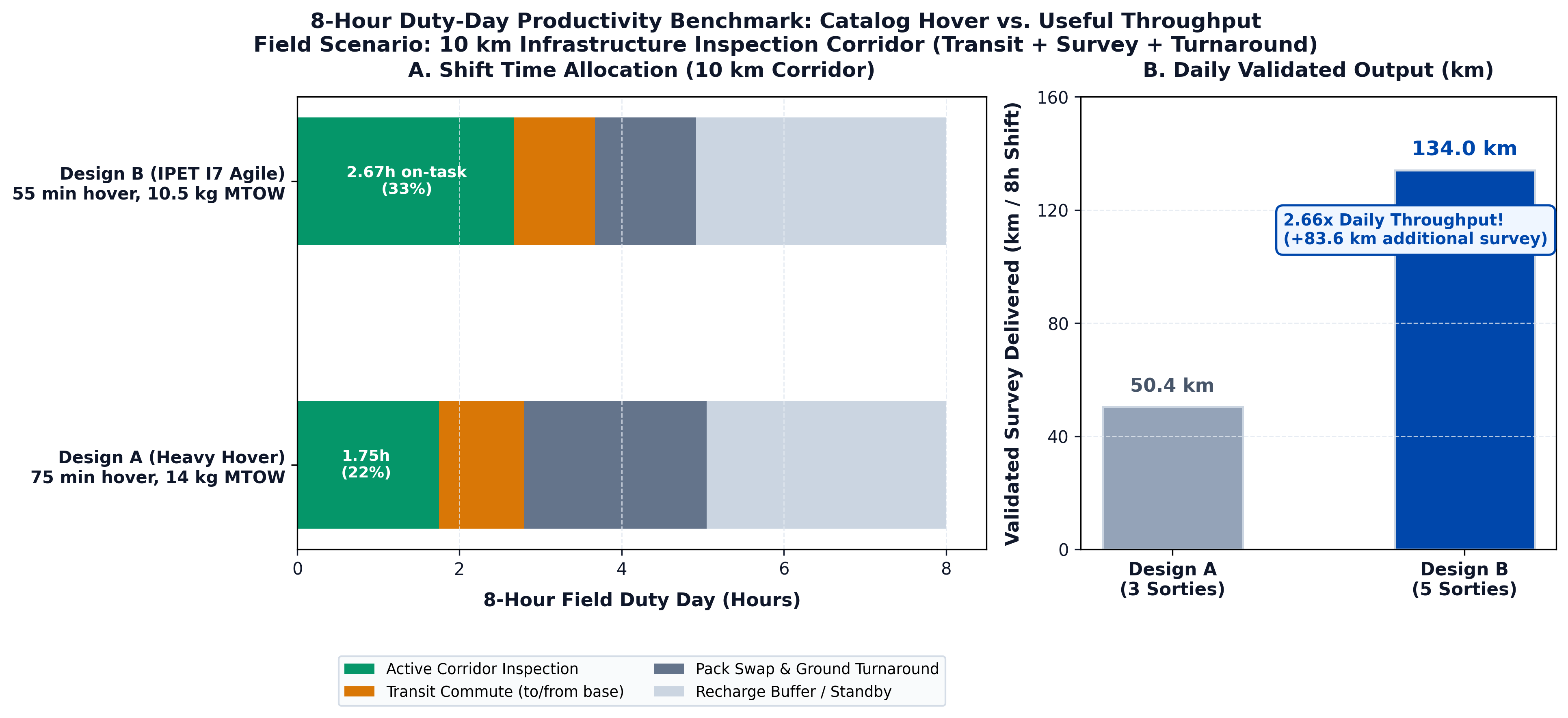
To demonstrate why catalog hover can mislead procurement teams, consider a real-world infrastructure inspection scenario: a 10 km linear corridor inspection (pipeline or transmission line) operated under typical 6 m/s crosswinds across an 8-hour field shift.
| Engineering Metric / Operating Parameter | Design A: "Maximize Catalog Hover" (Heavy Pack) | Design B: "Maximize Duty-Day Output" (IPET I7 Agile) |
|---|---|---|
| Powertrain & Airframe Architecture | Over-propped generic quad with 32" propellers | IPET I7 Integrated Propulsion with matched I30 carbon propellers |
| All-Up Takeoff Mass (MTOW) | 14.0 kg (high disk loading) | 10.5 kg (balanced industrial loading) |
| Battery Pack Sizing & Mass Fraction | 8.2 kg (12S 44,000 mAh, 58.6% mass fraction) | 5.2 kg (12S 28,000 mAh, 49.5% mass fraction) |
| Usable Inspection Payload | 1.8 kg (Dual thermal/EO gimbal + LiDAR) | 1.8 kg (Identical sensor payload retained) |
| Catalog Spec-Sheet Hover Time (Calm Air) | 75 minutes (wheels-up static hover) | 55 minutes (balanced operating point) |
| Transit Cruise Speed to 10 km Worksite | 11 m/s (sluggish response, pitch-limited in wind) | 17 m/s (responsive attitude control, dynamic margin) |
| Two-Way Transit Commute Time | 30.3 minutes per sortie | 19.6 minutes per sortie (35% less transit dead-time) |
| Effective On-Task Survey Speed in 6 m/s Wind | 8.0 m/s (restricted by attitude authority & vibration) | 14.0 m/s (stable high-speed sensor tracking) |
| Active Inspection Time per Flight | 35.0 minutes on corridor | 32.0 minutes on corridor |
| Validated Inspection Delivered per Sortie | 16.8 km / flight | 26.8 km / flight (+60% per sortie) |
| Ground Turnaround & Pack Handling | 45 minutes (heavy pack thermal cooldown + logistics) | 15 minutes (rapid pack swap, rapid thermal dissipation) |
| Total Sorties in 8-Hour Field Duty Day | 3 sorties (commute + swap consume 56% of shift) | 5 sorties (high duty-cycle utilization) |
| Total Validated Corridor Delivered / Day | 50.4 km / day | 134.0 km / day (2.66x productivity advantage!) |
Powertrain Rules Tied to Published Ratings
- Match MTOW to model band (see matrix): do not oversize into light-load inefficiency or undersize into high throttle.
- Score g/W at hover thrust—I7 rated at 2.6 kg; I8 rated at 4.0 kg.
- Watch bus limits: I-Series ESC max voltage is 61 V (12–14S class); no built-in BEC—power avionics separately.
- Harsh weather: I-Series is IP46 industrial dust/water; use N-Series when continuous rain/salt-fog sealing is the duty.
See also our companion engineering guides: Why Good Components Can Deliver Poor UAV Efficiency, the UAV Endurance Evidence Framework (L1–L6), the I-Series Selection Guide for Industrial Multirotors, and IPET Long-Endurance Solutions.
Conclusion: Buy Throughput
- Replace single-minute RFPs with the five-lens scorecard.
- Choose the I-Series (or N-Series) model whose rated hover point matches your per-rotor thrust.
- Validate with full-day mission logs from your routes.
Looking to size an optimized propulsion stack for your specific inspection or survey duty cycle? Consult IPET powertrain engineering for matched motor, ESC, and propeller sizing data.
Engineering FAQ
Separate commute from on-task time. A faster aircraft that reaches the corridor quickly can outperform a slower one with a longer catalog hover. If the clause is hard, improve operating-point efficiency before only adding battery mass.
Match rated hover thrust to your per-rotor load. I7 is rated at 2.6 kg/rotor (quad 10–14 kg class); I8 at 4.0 kg/rotor (quad 16–18 kg class). Confirm prop clearance and thermal margin for your route.
Validated deliverables per duty day including pack swap and turnaround—not hover minutes.