
IPET IV9(7224)

IPET IV9(7224)

An integrated IV9 (7224) propulsion system combining the motor, FOC IV150A ESC, and validated propeller configurations for 28–35 kg fixed-wing and VTOL UAVs. Designed for higher cruise thrust, stable thermal performance, and real-time propulsion feedback.

28–35 kgTarget MTOW
KV160 / KV190Available KV
12–14SRecommended Battery
1300 gWeight (Including Cable)

Engineering Fit Check

Use these parameters for initial cruise-propulsion selection. Final sizing should be verified against airframe drag, cruise speed, operating altitude, cooling conditions, propeller clearance, mission payload, and required power reserve.

Review Detailed Specifications
18.5 kgMax Thrust
24×12 / 22×10Recommended Propeller
956 WMax Continuous Power
IPX5Protection Rating
−30℃~60℃Recommended Ambient Temperature
PWM / CANESC Control Method

Integrated by Design Validated as a System

The motor, ESC, and validated propeller configurations are engineered as one propulsion architecture. This reduces integration work, improves system consistency, and provides a defined starting point for UAV platform development.

Motor and ESC Integration

A compact integrated architecture reduces external wiring, connector count, and installation complexity while supporting more consistent electrical and thermal performance.

Matched Propeller Setup

Propeller sizing is selected around the motor and ESC operating range to balance thrust, efficiency, current draw, and thermal load at the system level.

Faster Platform Integration

A defined propulsion configuration reduces component sourcing, compatibility testing, and repeated tuning during prototype development.

System Level Performance Data

Thrust, efficiency, current, RPM, and temperature are evaluated as a complete propulsion system to support airframe selection and validation.

Built for Reliable Fixed Wing Cruise

Designed for the continuous operating demands of larger fixed-wing and VTOL cruise platforms, with FOC control, shared-airflow thermal management, configurable propeller positioning, and redundant control and monitoring.

FOC Control and Shared Airflow Cooling

FOC control supports smooth and stable power delivery across the cruise operating range. A shared airflow path improves heat dissipation from both the motor and ESC during sustained output.

Adaptive Electronic Propeller Positioning

Configurable electronic positioning holds the propeller at a defined angle after shutdown and automatically adjusts the holding force against incoming airflow. This helps reduce blade-contact risk and supports lower-drag airframe integration.

ipet-iv7-iv9-vtol-propulsion-system
ipet-iv7-iv9-vtol-motor-cooling-design

Redundant Control and Real Time Monitoring

PWM and CAN provide two throttle-input paths for control redundancy. RPM and motor-temperature feedback support real-time propulsion monitoring and fault diagnosis when used with a compatible flight controller.

Secure Propeller and Mounting Interface

Anti-loosening stainless-steel fasteners, anti-slip teeth, and a removable locating pin help resist loosening and shear loads during installation, maintenance, and operation.

Where IV9 Fits Best

IV9 is intended for 28–35 kg fixed-wing and VTOL UAVs that require higher cruise thrust, stable propulsion output, and dependable integration for long-range missions with larger payloads.

IPET UAV large area mapping

Large Area Mapping and LiDAR Surveying

Supports larger fixed-wing and VTOL platforms carrying photogrammetry cameras, LiDAR, multispectral sensors, and heavier survey payloads across wide mission areas.

IPET UAV pipeline inspection

Long Range Linear Infrastructure Inspection

Suitable for extended inspection routes over transmission lines, pipelines, railways, roads, and coastal corridors, where additional thrust margin supports larger airframes and longer cruise segments.

IPET UAV offshore wind inspection

Remote Area and Emergency Monitoring

Suitable for fixed-wing and VTOL platforms used for disaster assessment, forestry patrol, coastline monitoring, and remote-area observation with heavier sensor or communication payloads.
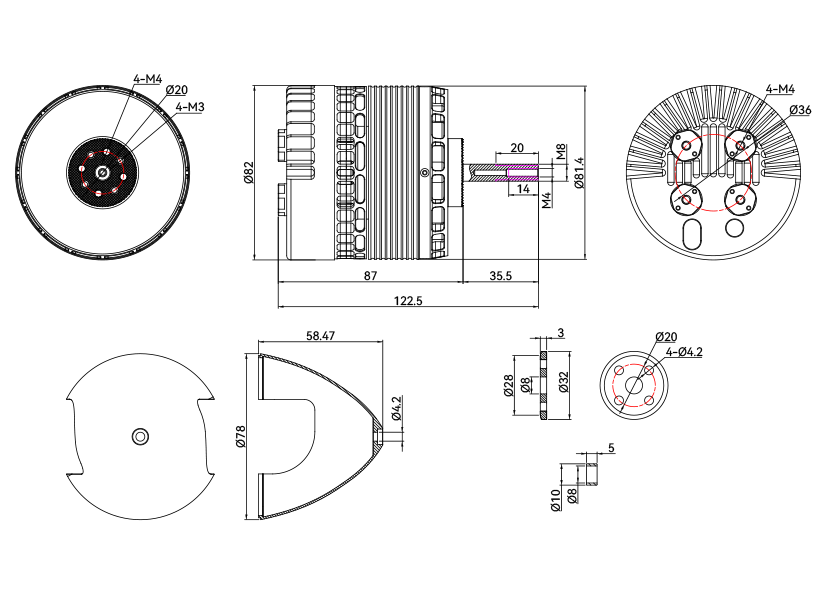
Technical Reference

Review mechanical fit, system specifications, matched motor and ESC data, and the complete engineering reference for this propulsion system.

Model No.IV9 (IV7224) KV160
SetupIV9 (IV7224) Motor+14S FOC IV150A ESC
Propeller22*10, 24*10, 24*12
Voltage12~14S (LiPo)
Max Continuous Power956W
Power CablesSilicone Wires-Red/Black-10AWG-1800mm
Signal WiresShielded Wire-Black-OD4.2-5C-1200mm-JP-3P*2-Black Blank White-Green Yellow Grey
Weight1300±2%g
IPIPX5
Recommended AmbientTemperature-3060℃
Model No.IV9 (IV7224) KV190
SetupIV9 (IV7224) Motor+14S FOC IV150A ESC
Propeller22*10
Voltage12S (LiPo)
Max Continuous Power881W
Power CablesSilicone Wires-Red/Black-10AWG-1800mm
Signal WiresShielded Wire-Black-OD4.2-5C-1200mm-JP-3P*2-Black Blank White-Green Yellow Grey
Weight1300±2%g
IPIPX5
Recommended AmbientTemperature-30~60℃

Stator Size72*24mm
KV160
Stator Size72*24mm
KV190

Throttle Pos. Range1040~1940us (Fixed)
ProtocolDRONE CAN/UAV CAN
Control MethodPWM/CAN
Throttle Refresh Rate50~500Hz
Max Voltage60V
Peak Output Current
(Last For 3s)
150A (Open Environment
With Temperature≤60℃)
BECNo
Throttle Response Speed300ms

IV7224_draw.png

Voltage
(V)
ThrottleCurrent
(A)
Thrust
(gf)
Torque
(N·m)
Speed
(RPM)
Power
(W)
Efficiency
(gf/W)
4830%2.8213380.4720211359.88
4835%4.1718870.6223662009.42
4840%5.9925370.8427192888.82
4845%8.4033181.0430744038.22
4850%11.2541471.3134265407.68
4855%14.8250631.5937807127.11
4860%19.2261391.8841309236.65
4865%24.2572392.25448011656.21
4870%30.3284602.59483114565.81
4875%37.6398433.02518318065.45
4880%46.83114333.48553822475.09
4885%57.69131384.00590827674.75
4890%71.79153774.47633134394.47
4895%92.72175845.44674344393.96
48100%100.02184675.73689947873.86
4830%3.1615790.55200715210.38
4835%4.7721970.7523592299.58
4840%6.8729340.9727103318.87
4845%9.5937781.2430614628.19
4850%12.9947171.5234106257.55
4855%17.2257901.8737588286.99
4860%22.2769602.21410510716.50
4865%28.3982242.59445113646.03
4870%35.2496203.07479516945.68
4875%44.34111143.54514821305.22
4880%54.82127874.10550226324.86
4885%68.17146834.69587232724.49
4890%86.99170355.43629841704.09
4895%98.84183625.86651047383.88
48100%98.82183415.86650947363.87
4830%3.1415930.5125681888.47
4835%4.5921880.6729942757.97
4840%6.5229150.8834333907.47
4845%9.0037661.1238765396.99
4850%12.1447571.4043227276.55
4855%15.9758471.6847659566.12
4860%20.6570362.03521112365.69
4865%26.4684172.39565515845.32
4870%33.4599052.83611220014.95
4875%41.81115723.29655825014.63
4880%52.18134233.91702131204.30
4885%65.33155084.49749839043.97
4890%86.18173365.37806151403.37
4895%105.91184586.11845263182.92
48100%105.79184436.10844063092.92
4830%3.8514980.4725211858.11
4835%5.5020600.6229252647.82
4840%7.6527210.8133373677.42
4845%10.4634991.0337655016.98
4850%14.0744411.2741966756.58
4855%18.3954371.5646278816.17
4860%23.8865941.88505411445.76
4865%30.2877962.21548114515.37
4870%37.8991512.56590718155.04
4875%47.24106783.01633822634.72
4880%58.51123213.47676928014.40
4885%72.21140943.96721034564.08
4890%88.66165474.57769642393.90
4895%122.18173935.63821758322.98
48100%121.67173795.61820358082.99
Note: Motor temperature is the motor surface temperature at 100% throttle running 3min.
(Data above based on IPET SYSTEM benchtest are for reference only. Final interpretation rights reserved by IPET SYSTEM.)

Download Center

Access the core files needed for engineering review. For the complete resource library, visit the global Download Center.

Request Full Dataset

IPET-IV9(7224) Product Specification & Operation Guide(V1)

Updated : 2026-06-18
pdf

IPET-IV9(7224) Specifications & Technical Drawing

Updated : 2026-05-12
pdf

IPET-IV9(7224) Bench Test Data

Updated : 2026-05-12
pdf

IPET-IV9(7224) 3D Model (STEP)

Updated : 2026-04-28
zip
Is it normal for the IV9(7224) motor to keep beeping after power-on?
Yes, this is normal. After power-on, the ESC performs a self-check, and the initial beeping comes from this startup process. The motor will only start after it receives a valid PWM throttle signal. If the motor does not spin after self-check, please check the flight controller’s PWM output and arming status.