
In industrial UAV platform design, achieving extended flight time is often approached with a brute-force mindset: if the aircraft does not fly long enough, fit a larger battery. However, multirotors operate strictly on dynamic lift principles. Adding battery mass increases aircraft gross weight, elevates required hover thrust, degrades propeller g/W efficiency, and accelerates continuous current draw.
To establish verified engineering parameters for commercial OEM teams sizing long-endurance platforms around the IPET I7 Integrated Propulsion System, this technical report evaluates real-world flight test telemetry on a standardized 1000mm industrial quadcopter airframe. We analyze empirical hover data from a baseline 12S 36Ah pack and model three commercially available battery configurations from mPower (22Ah Solid State, 35Ah Lithium-Ion, and 42Ah Lithium-Ion) to quantify the exact trade-offs between battery mass, operating point efficiency, and usable flight time.
- Baseline Benchmark: 1000mm Quadcopter + IPET I7 + 12S 36Ah achieves 2 hours 14 seconds (120.2 min) verified hover at 10.25 kg MTOW and 17.96 A.
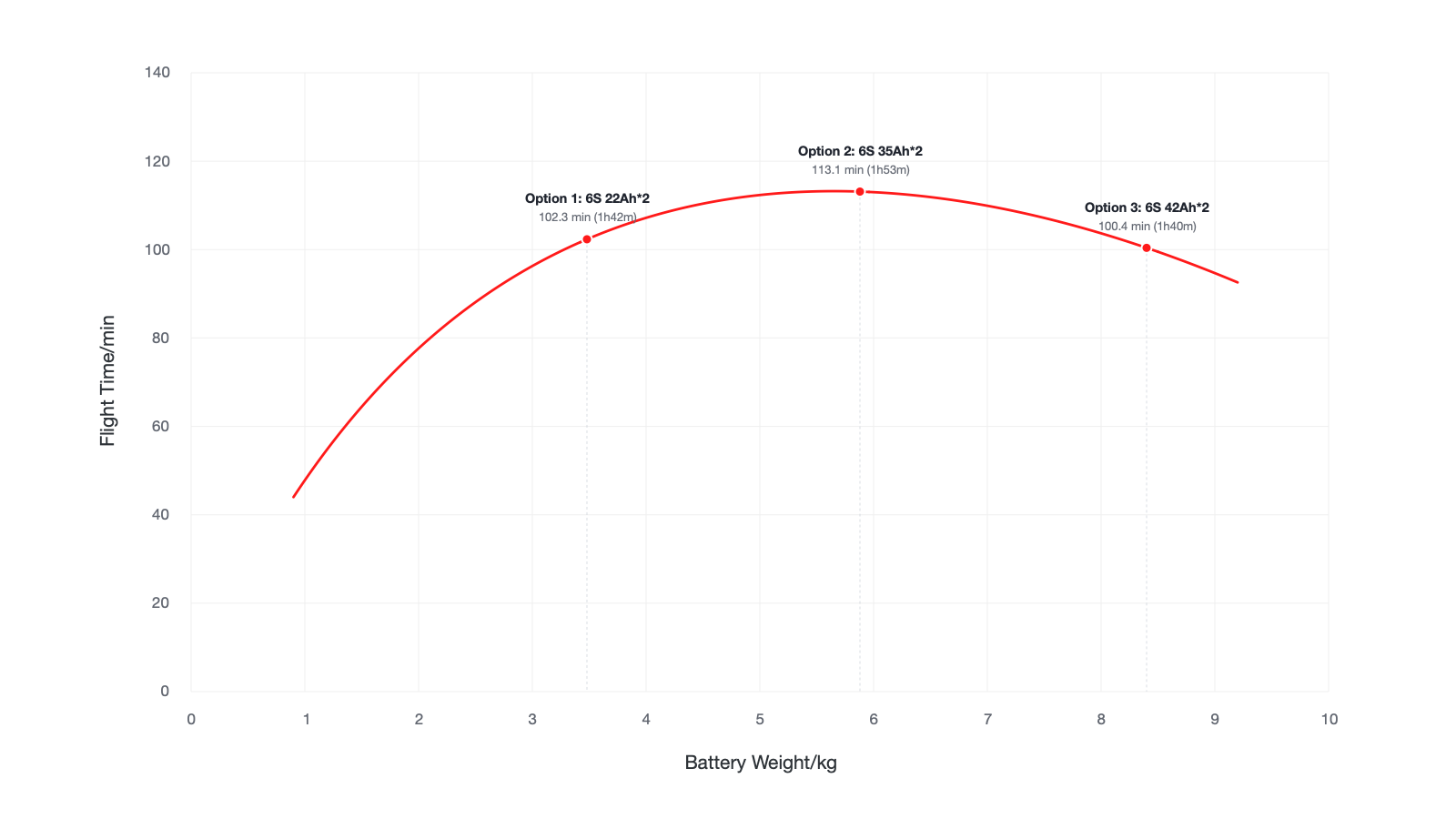
- Sweet-Spot Commercial Sizing: mPower 6S 35Ah × 2 (12S 35Ah, 5.88 kg) delivers 113.1 minutes hover endurance at 10.48 kg MTOW.
- High-Agility / Payload Sizing: mPower 6S 22Ah Solid State × 2 (12S 22Ah, 3.48 kg) achieves 102.3 minutes while freeing 2.40 kg payload margin with a 3.71:1 thrust-to-weight ratio.
- Negative Return Warning: Sizing up to mPower 6S 42Ah × 2 (12S 42Ah, 8.40 kg) increases MTOW to 13.00 kg, driving current to 25.05 A and reducing flight time to 100.4 minutes (-12.7 min vs 35Ah).
Baseline Flight Test: 120-Minute Telemetry Log
Field testing was conducted under cold, light-wind ambient conditions to calibrate the steady-state hover operating point of the IPET I7 integrated powertrain. The official flight test record is logged below:
| Parameter | Test Specification | Parameter | Test Specification |
|---|---|---|---|
| Airframe Platform | 1000mm Wheelbase Industrial Quadcopter | Battery Configuration | 12S 36Ah |
| Powertrain Package | IPET I7 Integrated Propulsion | Discharged Capacity | 35,935 mAh (99.8% DoD) |
| Propeller Setup | 30-inch Ultra-Light Carbon Blades | Voltage Range | 50.9V - 31.2V (2.60V/cell cutoff) |
| Takeoff Weight (MTOW) | 10.25 kg | Measured Hover Current | 17.96 A continuous |
| Environmental Conditions | Overcast, 5°C, Beaufort Scale 2 | Verified Hover Time | 2h 00m 14s (120.2 min) (tested) |
Telemetry Deconstruction and Electrical Characteristics
- Series 12S Architecture: Two 6S packs are connected in series to form a 12S battery bus (initial voltage 50.9V / 12 ≈ 4.24V/cell; landing cutoff 31.2V / 12 = 2.60V/cell).
- High-Density Chemistry: The low 2.60V cutoff and 99.8% depth-of-discharge (35,935 mAh usable out of 36,000 mAh nominal) confirm high-energy-density semi-solid lithium cells (~280 Wh/kg).
- Airframe Empty Weight: The dual 6S 36Ah battery assembly weighs approximately 5.65 kg. Deducting this from the 10.25 kg MTOW establishes the dry airframe weight (carbon frame, I7 motors, ESCs, 30-inch props, flight controller, and avionics) at 4.60 kg.
- Verifiable Mathematical Proof: Hover Endurance = Usable Capacity / Average Current = 35.935 Ah / 17.96 A = 2.0008 Hours = 120 minutes 14 seconds.
The Aerodynamic and Power Scaling Model
In multirotor hover aerodynamics, rotor induced power scales non-linearly with thrust according to momentum theory: Pinduced ∝ T1.5. Accounting for blade profile drag and motor-ESC electromechanical efficiency curves, the hover power consumption of large-diameter direct-drive systems scales with weight to the 1.40 power:
Key Engineering Formulation: Hover Current and Endurance Scaling
Iavg(W) = I0 × ( W / W0 )α = 17.96 × ( W / 10.25 )1.40
T(Wb) = [ Cusable(Wb) / Iavg(4.60 + Wb) ] × 60
Where Wempty = 4.60 kg, Wb is the battery mass in kilograms, and Cusable(Wb) represents the usable capacity delivered by the pack configuration under a 12S series bus.
Battery Weight vs. Hover Endurance Curve
Applying the calibrated aerodynamic model to the commercially available mPower battery tiers across a 1 kg to 10 kg mass envelope defines the hover endurance curve. The model captures the initial steep rise in endurance, the plateau at optimal capacity, and the subsequent decline caused by battery deadweight saturation:
Comparative Sizing Matrix: 22Ah vs. 35Ah vs. 42Ah
To evaluate practical off-the-shelf options, the table below compares three commercial drone battery packages from mPower Lithium across key operational metrics on the 1000mm IPET I7 platform:
| Design Parameter | Option 1: Lightweight | Option 2: 6S 35Ah × 2 | Option 3: Max Sized |
|---|---|---|---|
| Battery Model | mPower 6S 22Ah Solid State | mPower 6S 35000mAh Li-Ion | mPower 6S 42000mAh Li-Ion |
| Battery Configuration | 6S 22Ah × 2 (12S 22Ah) | 6S 35Ah × 2 (12S 35Ah) | 6S 42Ah × 2 (12S 42Ah) |
| Battery Chemistry | Solid State / Semi-Solid | Cylindrical Lithium-Ion | Cylindrical Lithium-Ion (11C) |
| Battery Pack Mass | 3.48 kg (1.74 kg × 2) | 5.88 kg (2.94 kg × 2) | 8.40 kg (4.20 kg × 2) |
| Takeoff Weight (MTOW) | 8.08 kg (-2.17 kg) | 10.48 kg (+0.23 kg) | 13.00 kg (+2.75 kg) |
| Usable Capacity | 21,956 mAh | 34,930 mAh | 41,916 mAh |
| Continuous Hover Current | 12.87 A (-28.3%) | 18.53 A (+3.2%) | 25.05 A (+39.5%) |
| Single-Axis Hover Power | ~143 W | ~200 W | ~271 W |
| Hover Flight Time | 1h 42m (102.3 min) | 1h 53m (113.1 min) | 1h 40m (100.4 min) |
| Endurance Delta vs Baseline | -17.9 min (-14.9%) | -7.1 min (-5.9%) | -19.8 min (-16.5%) |
| Dynamic Thrust-to-Weight | 3.71 : 1 (high agility) | 2.86 : 1 (optimal balance) | 2.31 : 1 (heavy loaded) |
| Operational Mission Focus | Agile inspection in wind; payload margin for LiDAR / gimbal | Commercial sweet spot for surveillance and long-range patrol flights | Negative return zone: +2.52 kg deadweight reduces flight time by 12.7 min vs 35Ah |
The Law of Diminishing Marginal Returns in Battery Sizing
A critical revelation emerges from comparing the three commercial battery tiers and the sizing matrix:
- From 22Ah (3.48 kg) to 35Ah (5.88 kg): Adding 2.40 kg of battery mass increases usable flight time by 10.8 minutes (from 102.3 min to 113.1 min). This represents a positive engineering trade-off for surveillance missions requiring maximum airtime without external payload.
- From 35Ah (5.88 kg) to 42Ah (8.40 kg): Adding 2.52 kg of battery mass actually reduces flight time by 12.7 minutes (dropping from 113.1 min down to 100.4 min).
Why 42Ah Underperforms 35Ah: Deadweight vs. Disc Loading
The 42Ah pack utilizes high-discharge cylindrical cells with an energy density of ~216 Wh/kg (compared to ~257 Wh/kg on the 35Ah pack and ~280 Wh/kg on the 22Ah solid-state pack). When two 4.20 kg packs are fitted, total aircraft mass reaches 13.00 kg, where battery mass accounts for nearly 65% of the gross takeoff weight. At 13 kg, continuous current surges to 25.05 A (+35% above the 35Ah tier), forcing the 30-inch carbon blades to operate at elevated disc loading and degraded g/W aerodynamic efficiency, while accelerating resistive I2R thermal losses.
Conclusion: Sizing Recommendations for OEM Platforms
Flight endurance in multirotor platforms is not a simple linear function of battery capacity. It is the aerodynamic balance between airframe dry weight, battery gravimetric density, and motor efficiency curves.
Recommended Selection by Mission Profile
- Commercial Surveillance and Perimeter Patrol: Select mPower 6S 35000mAh × 2 (12S 35Ah, 5.88 kg). It delivers 113.1 minutes (1h 53m) of continuous hover at the powertrain's electromagnetic sweet spot.
- Industrial Inspection and Sensor Payloads: Select mPower 6S 22Ah Solid State × 2 (12S 22Ah, 3.48 kg). Shedding 2.40 kg of battery deadweight provides the vital payload margin needed to carry LiDAR or optical zoom gimbals while keeping the I7 operating with exceptional dynamic agility (3.71:1 TWR) and 102 minutes of base endurance.
- Oversized Packs to Avoid: Avoid battery configurations exceeding 6.0 kg (such as 42Ah / 8.40 kg). Beyond this threshold, additional battery weight degrades flight duration, increases disc loading, and creates excessive motor-ESC thermal stress.
Engineering FAQ: Multirotor Battery Sizing
How does battery weight affect multirotor hover flight time?
Hover power consumption scales non-linearly with aircraft gross weight according to momentum theory (P ∝ W1.40). Adding excessive battery mass increases continuous current draw, degrades propeller disc efficiency (g/W), and eventually causes diminishing marginal returns where extra battery deadweight burns more energy than it stores.
Why does the 42Ah battery achieve shorter flight time than the 35Ah battery on a 1000mm quadcopter?
The 12S 42Ah cylindrical lithium-ion battery weighs 8.40 kg, raising aircraft takeoff mass to 13.00 kg. Continuous current surges to 25.05 A (+35.2% over the 35Ah setup), accelerating resistive I²R heat losses and propeller disc loading, causing hover duration to drop from 113.1 minutes to 100.4 minutes.
What is the optimal battery choice for commercial payload operations on the IPET I7?
For missions carrying LiDAR, zoom cameras, or sensor gimbals, the 12S 22Ah solid-state battery (3.48 kg) is optimal. It achieves 102.3 minutes of base flight time while saving 2.40 kg of deadweight, enabling high payload capacity and a 3.71:1 dynamic thrust-to-weight ratio for strong wind resistance.